
Most patients arrive at this comparison with a specific frustration: a standard facial left their skin looking briefly brighter, but it never touched the congestion, breakouts, or uneven texture that keeps coming back. Weighing HydraFacial vs Regular Facial treatments really comes down to one question: does a device driven clinical treatment produce outcomes that a skilled aesthetician working by hand simply cannot match? Backed by clinical research rather than marketing claims, the answer is more concrete than most people expect.

HydraFacial vs Regular Facial: What Happens During Each Treatment
A regular facial is a hands on service. Steam opens the pores, an aesthetician performs manual extractions by hand, and a massage plus topical mask finish the appointment. The results depend heavily on the practitioner’s technique, the products used that day, and how the skin happens to respond to physical pressure.
HydraFacial works on a different mechanical principle. The device combines vortex suction technology with targeted serums to cleanse, exfoliate, and extract debris from the follicles in a single continuous pass, rather than relying on manual pressure and layered products. That distinction is not cosmetic. Excess sebum, dead skin cells, and bacterial buildup sit inside the follicular structure in ways that manual pressure alone struggles to reach consistently.
Vortex Suction vs Manual Extraction
Manual extraction relies on a trained eye and a steady hand, and outcomes vary from one appointment to the next depending on how the skin reacts that day. Vortex suction performs the same basic job, pulling debris out of the follicle, but does it with continuous, calibrated suction instead of finger pressure. For most patients that means a more even result across the whole face rather than a few well worked problem areas.
Hydradermabrasion vs Traditional Microdermabrasion
The classification difference between hydradermabrasion and older microdermabrasion methods matters too. Traditional microdermabrasion uses dry crystals or a diamond tip to mechanically abrade the surface, which can leave already sensitive skin more reactive afterward. Hydradermabrasion takes a wetter approach: the device infuses hydrating serums into the skin at the same time it exfoliates, so the treatment supports the skin barrier instead of stripping it. For sensitive or reactive skin, that single difference changes the entire recovery experience, since the skin is resurfaced and replenished in the same pass rather than stripped and left to recover on its own.
Acne in America: Why This Comparison Matters
Acne is not a minor cosmetic concern for most people asking this question. According to the American Academy of Dermatology, acne affects more than 50 million Americans annually, making it the most common skin condition in the United States. Roughly 85 percent of people between the ages of 12 and 24 experience at least minor acne, and the condition continues into adulthood for up to 15 percent of women. That scale is exactly why so many people want to know whether a device based treatment actually outperforms a manual one, rather than settling for whichever service happens to be on a spa menu.
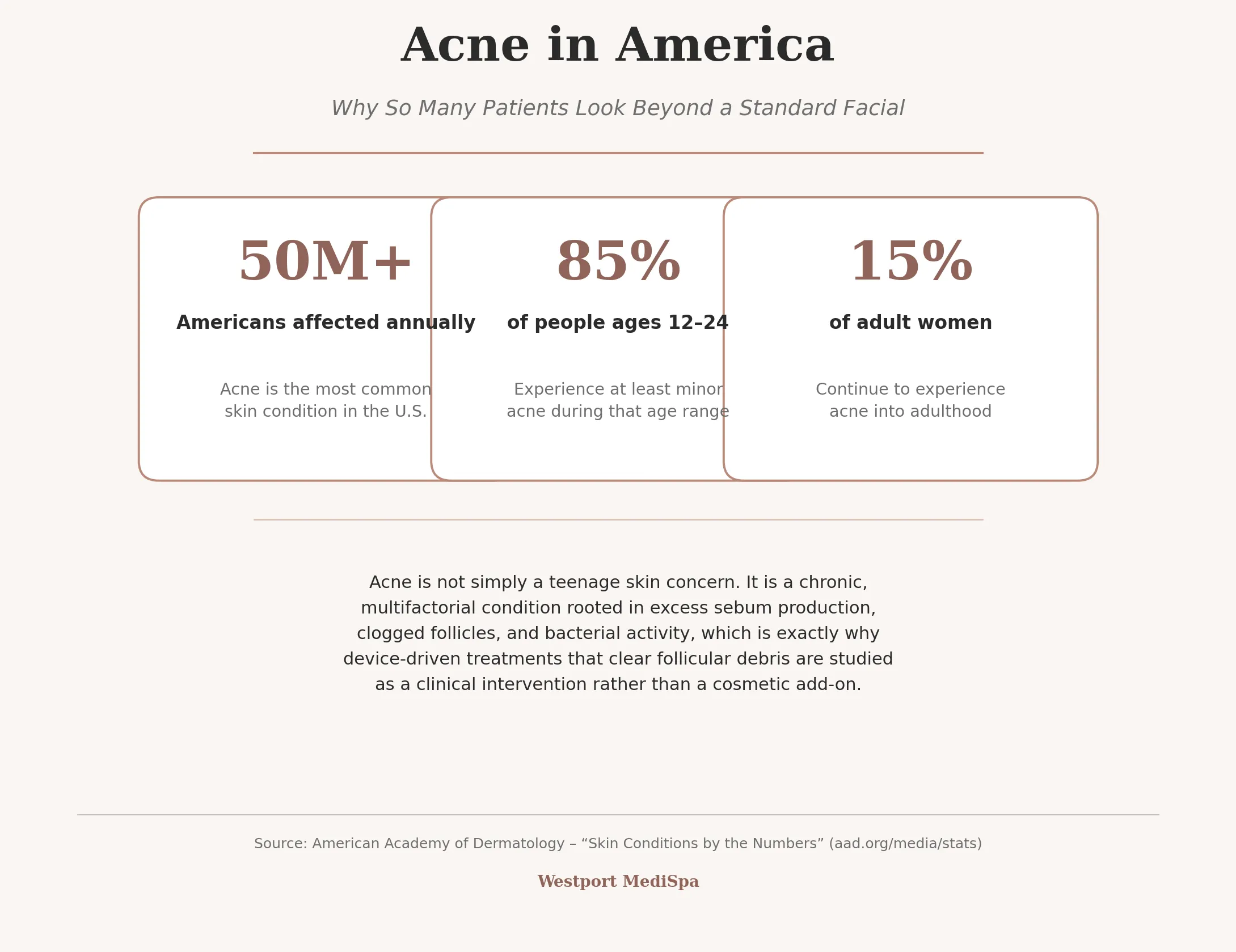
Source: American Academy of Dermatology, “Skin Conditions by the Numbers.”
Acne itself is multifactorial. Clogged follicles, excess oil production, and bacterial activity all play a role, which is precisely what a vortex suction and blue LED light protocol is built to interrupt. A regular facial can certainly clean the surface, but it was never designed to address all three factors at once in a single visit.
Inside the Three Step HydraFacial Protocol
What separates a clinical treatment series from a single spa visit is structure. A HydraFacial treatment follows the same repeatable, three step protocol at every appointment, which is part of why the results are so consistent from one session to the next:
- Step 1, Cleanse and Peel: Activ-4 and GlySal solutions exfoliate and resurface the skin using glycolic acid and salicylic acid, loosening dead cells and preparing the follicles for extraction.
- Step 2, Exfoliate and Suction: A Beta-HD solution performs deep pore extraction through vortex suction, followed by several minutes of blue LED light therapy to target acne causing bacteria at the follicular level.
- Step 3, Hydrate and Protect: An antioxidant and peptide rich solution is infused into the skin to lock in moisture and support barrier recovery after exfoliation.
For more persistent or inflamed breakouts, some patients pair a HydraFacial series with a dedicated laser acne treatment to address deeper inflammation that suction alone cannot fully resolve.
What 12 Weeks of Clinical Data Actually Show
A 12 week, multicenter clinical study published in the Journal of Clinical and Aesthetic Dermatology tracked twenty adult patients with mild to moderate acne through six HydraFacial Clarifying Treatments, spaced two weeks apart. Investigators and patients both used the Global Acne Severity Score, a standardized grading tool, to track change over the course of the series.
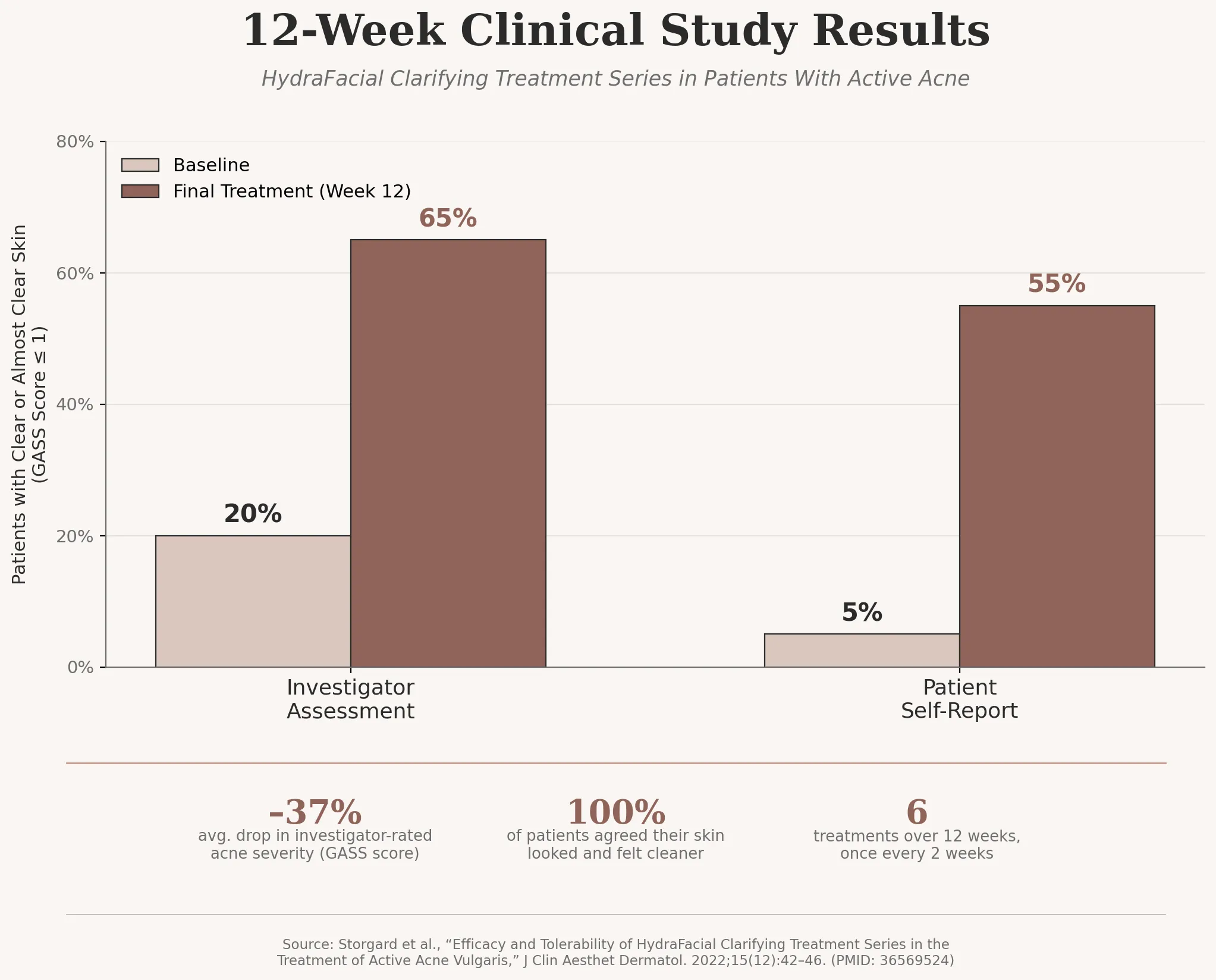
Source: Storgard et al., Journal of Clinical and Aesthetic Dermatology, 2022.
The proportion of patients with clear or almost clear skin rose from 20 percent to 65 percent by investigator assessment, and from 5 percent to 55 percent by patient self-report. Mean investigator scores dropped 37 percent over the course of the series, and mean patient scores dropped 34 percent. Those improvements held through a two week follow up period, and by the final treatment, 100 percent of patients agreed their skin looked and felt cleaner.
No published study has directly compared HydraFacial against a manual facial in a head to head trial, so claims of outright superiority rest partly on mechanism rather than a controlled comparison. What the data does establish clearly is that a structured HydraFacial series produces statistically significant, measurable improvement in acne severity, an outcome a standard facial has not been studied to match.
HydraFacial vs Regular Facial: Which Wins for Active Acne?
For active breakouts, the evidence favors HydraFacial. Manual extractions performed by hand carry a real risk of spreading bacteria or aggravating inflamed lesions, a risk that vortex suction avoids by design. A regular facial remains a reasonable option for general maintenance, but it has not been studied as an acne treatment the way HydraFacial has.
Where a Regular Facial Still Has an Edge
A regular facial has genuine strengths worth acknowledging. An experienced aesthetician can feel congestion under the skin and adjust pressure in real time in a way no automated protocol can replicate. The massage component supports circulation, and the sensory experience of warmth, scent, and touch triggers a relaxation response that a clinical treatment rarely matches. Patients who mostly want a manual, low-tech exfoliating option can find that in dermaplaning, which delivers immediate smoothing without any device involved.
For patients who want something between a manual treatment and a more intensive procedure, PRX skin revitalization offers a no peel option that sits between a standard facial and a deeper resurfacing treatment.
Comfort, Downtime, and Cost Side by Side
Beyond the clinical data, the practical differences in day to day experience often decide which treatment a patient chooses:
| Factor | Regular Facial | HydraFacial |
| Comfort | Manual squeezing during extractions can be uncomfortable and cause temporary redness | Automated vortex suction clears pores without manual pressure |
| Downtime | Skin can look flushed or blotchy for up to 24 hours after aggressive extraction | Essentially none, with a clean, even glow immediately after treatment |
| Customization | Adjusted through product selection and hand technique | Calibrated with targeted boosters and integrated LED light therapy |
| Cost Per Session | Generally lower upfront cost | Higher upfront cost, but consolidates exfoliation, extraction, LED therapy, and hydration into one visit |
Patients focused on texture and fine lines rather than active breakouts sometimes look at microneedling as another way to stimulate collagen production once acne itself is under control.
Measuring Results the Right Way
Satisfaction claims are easy to make and hard to verify unless they are measured with a validated tool. FACE-Q, a patient reported outcome scale developed and psychometrically validated in a study published in JAMA Dermatology, is now used across cosmetic dermatology and plastic surgery to standardize how patients rate visible results and side effects. That level of accountability is part of why the HydraFacial acne study carries real weight: it used a structured grading tool rather than open-ended feedback.
“Dr. Dana Brownell is a brilliant artist and master of her trade in the newest, most state of the art technology in aesthetic non-surgical cosmetology. With an incredible eye, her understanding of what techniques are needed to obtain exceptional youthful results far surpasses any of the best of the best doctors.” – Kate B.
That same clinical rigor shapes every treatment plan, drawing on Dr. Dana Brownell’s background in aesthetic medicine to match the protocol to each patient’s skin rather than defaulting to whatever treatment is trending.
So Which Treatment Is Right for You?
Choosing between HydraFacial and a regular facial is not really a question of which treatment is universally better. It is a question of what the skin actually needs and what outcome someone is working toward. Some people benefit most from the deep mechanical cleansing and LED therapy of a clinical hydradermabrasion series. Others are well served by the tactile, customizable nature of a manual treatment, and many benefit from both, sequenced carefully over time as part of a broader range of advanced skin resurfacing treatments.
That kind of individualized planning reflects Westport MediSpa’s overall approach to skin care, built around a thorough evaluation rather than a one size fits all menu.
Frequently Asked Questions About HydraFacial and Regular Facials
What is the main difference between a HydraFacial and a regular facial?
A HydraFacial uses device driven vortex suction technology and active, pharmaceutical grade ingredients to target specific skin concerns with a consistent, repeatable process. A regular facial is a manual, relaxation oriented treatment where the outcome depends on the aesthetician’s technique and product selection rather than a standardized protocol.
Is a HydraFacial better than a regular facial for active acne?
For active acne, the clinical evidence favors HydraFacial. A 12 week study found that the proportion of patients with clear or almost clear skin rose from 20 percent to 65 percent based on investigator assessments across a six treatment series. Manual extractions carry a real risk of spreading bacteria or irritating inflamed lesions, an outcome vortex suction avoids by design.
How long do HydraFacial results last compared to a regular facial?
The immediate glow and hydration from a HydraFacial typically last five to seven days, which tends to be more pronounced and longer lasting than the temporary brightness a regular facial produces. For durable skin health improvement, a structured series is generally recommended, since the compounding benefit of repeated treatments is where the more meaningful clinical outcomes show up.
Who should avoid a HydraFacial treatment?
People with active sunburn, severe rosacea, uncontrolled open rashes, or those who have recently had aggressive laser treatments or deep chemical peels should hold off on a HydraFacial until those conditions resolve. A thorough skin evaluation before treatment helps confirm the protocol is appropriate and safe for each individual.
Is a HydraFacial worth the investment compared to a regular facial?
For people seeking visible, clinically grounded results with essentially no downtime, the answer is generally yes. A single HydraFacial session delivers the equivalent of a chemical exfoliation, mechanical extraction, LED therapy session, and hydration infusion, steps that would otherwise require several separate appointments. Whether it is the right investment still depends on individual skin goals, which is exactly what a thorough consultation is meant to answer.